
Someone buys an e-bike off Lazada for $450. It looks like a normal bike. It goes 40 km/h. They ride it to work every day for three months — until an LTA officer flags them at a park connector checkpoint. The bike gets impounded. The rider faces a fine of up to $10,000.
This situation is more common than people realise. In 2025, LTA seized around 900 non-compliant active mobility devices and recorded about 900 related offences.
If you are buying an e-bike in Singapore or already own one, the speed limit is one of the most important things you need to understand — not because the rules are complicated, but because the consequences of getting it wrong are serious.
This article explains the legal ebike speed limit in Singapore, what LTA does to enforce it, and how to make sure the bike you buy keeps you on the right side of the law.
What Is The Legal E-Bike Speed Limit in Singapore?
Quick Answer: The maximum assisted speed for a Power-Assisted Bicycle (PAB) in Singapore is 25 km/h. This applies on roads, cycling paths, and Park Connector Networks (PCNs). The motor must not exceed 250 watts of continuous rated power. All PABs must comply with the EN15194 safety standard. Going over 25 km/h under motor power is illegal — and so is modifying your bike to go faster.
The Land Transport Authority sets out the rules for PABs under the Road Traffic (Power-Assisted Bicycles) Rules and the Active Mobility Act.
Here is what the law says in plain English:
- Speed: Motor assistance must stop when the bike reaches 25 km/h. Power must reduce progressively as the bike approaches that limit.
- Motor power: Maximum 250 watts continuous rated output.
- Safety standard: All PABs must comply with EN15194 (the European standard for electric bicycles). This is a separate requirement from the UL2272 fire safety standard, which applies to PMDs (e-scooters), not PABs.
- Weight: Maximum unladen weight of 20 kg.
- Width: Maximum 70 cm.
A PAB is different from a PMD. A PAB has pedals and looks like a bicycle. It assists you while you pedal — it does not propel you without pedalling. The 25 km/h rule applies to the motor-assisted speed, not your total speed if you are pedalling hard on a downhill.
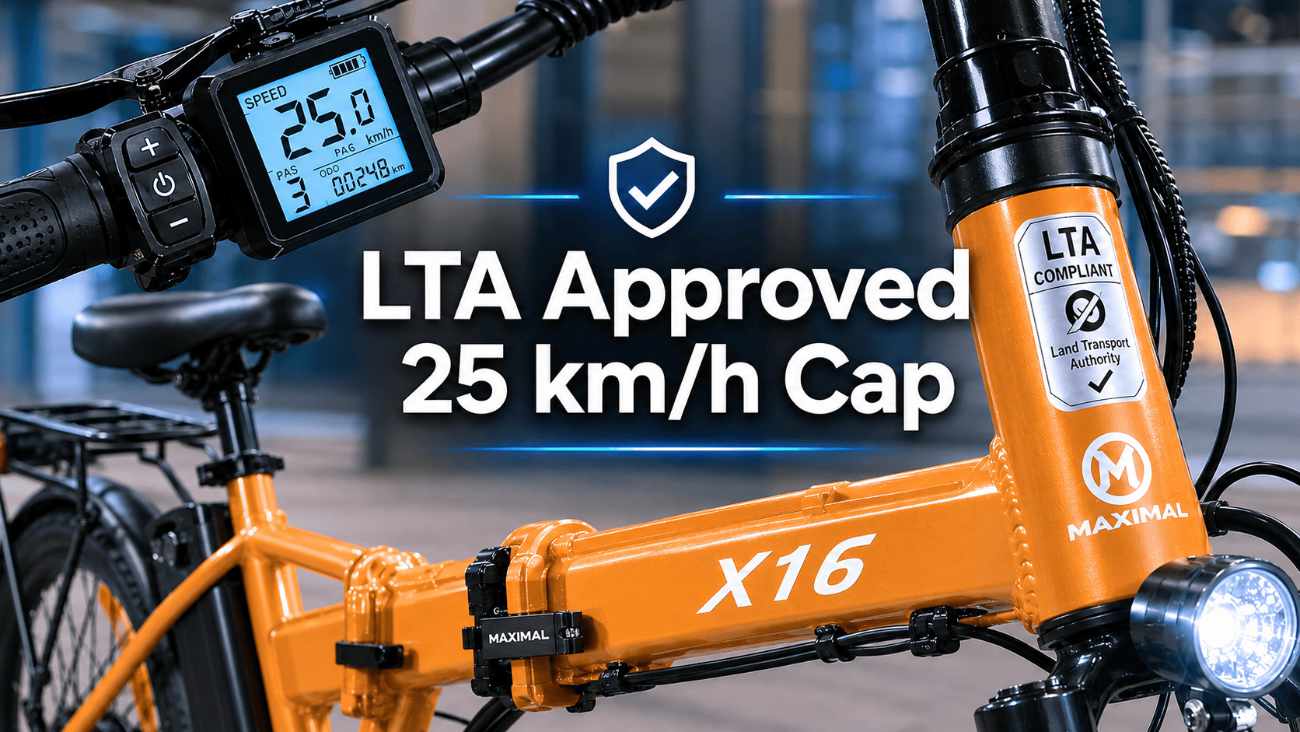
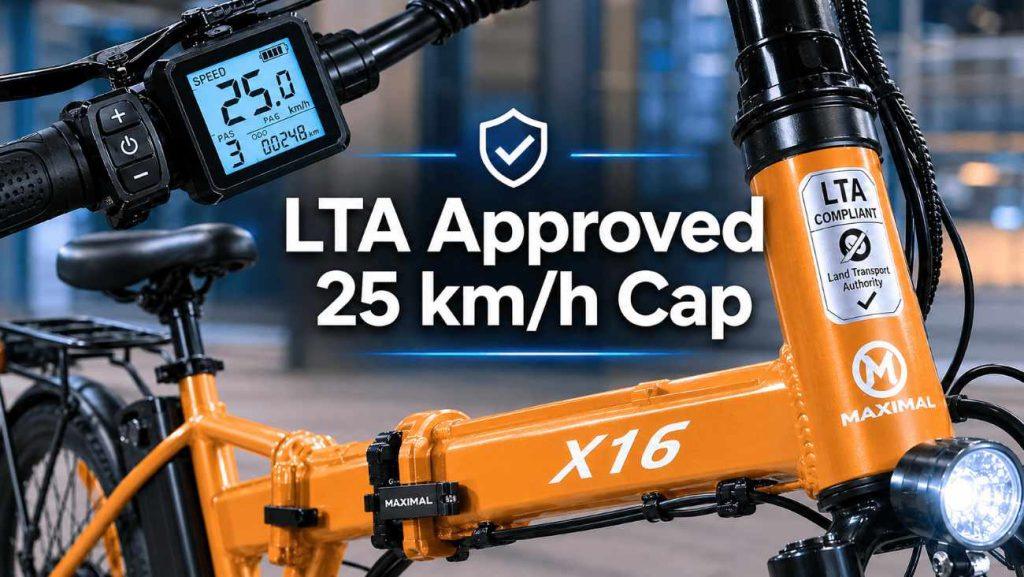
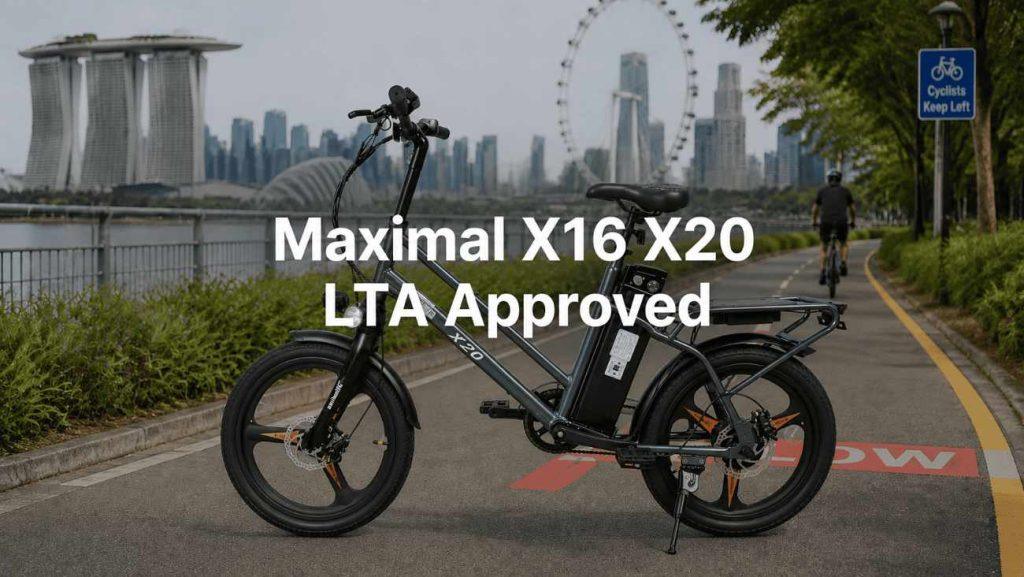
Both the Maximal X16 (Model No. PAB-16-02) and the Maximal X20 (Model No. PAB-20-05) are LTA-approved PABs. Their 48V 250W motors are capped at 25 km/h in line with LTA requirements — this is set at the factory and is not something riders adjust.
What Actually Happens If You Go Over 25 km/h
LTA’s enforcement has strengthened significantly since 2025. Here is what you are looking at if you ride or own a non-compliant e-bike:
The penalties for using a non-compliant AMD (Active Mobility Device):
- First-time offenders: fine of up to $10,000, or imprisonment for up to 6 months, or both.
- Repeat offenders: fine of up to $20,000, or imprisonment for up to 12 months, or both.
These are not parking ticket-level fines. A $10,000 penalty for riding a modified e-bike is a serious legal consequence.
Enforcement is getting harder to avoid. In November 2025, LTA deployed a new speed measurement device developed with Temasek Polytechnic. It can detect whether an AMD has been modified to exceed 25 km/h even when the device is stationary. Previously, officers could only catch speeding riders in the act. Now they can test a bike at a checkpoint without it moving.
Since the device was first deployed, it contributed to the detection of over 100 offences and the impoundment of 30 non-compliant devices within a few months. In February 2026, LTA ran a single-day operation in Admiralty that resulted in 19 AMDs being impounded and 36 offences detected.
Where does LTA check? Operations are run at parks, park connectors, and public paths. Officers stop riders and can now test devices on the spot. You do not need to be caught speeding — a modified device can be detected while parked.
The fire risk angle matters too. In 2025, Singapore recorded 49 fires involving active mobility devices. LTA cites fire risk as one of the main reasons it enforces device standards so strictly. Non-compliant batteries and modified controllers increase fire risk significantly.
How To Know If Your E-Bike Is LTA-Compliant
Not all e-bikes sold in Singapore are legal to ride on public paths. Here is how to check before you buy.
1. Look for the LTA Orange Tag.
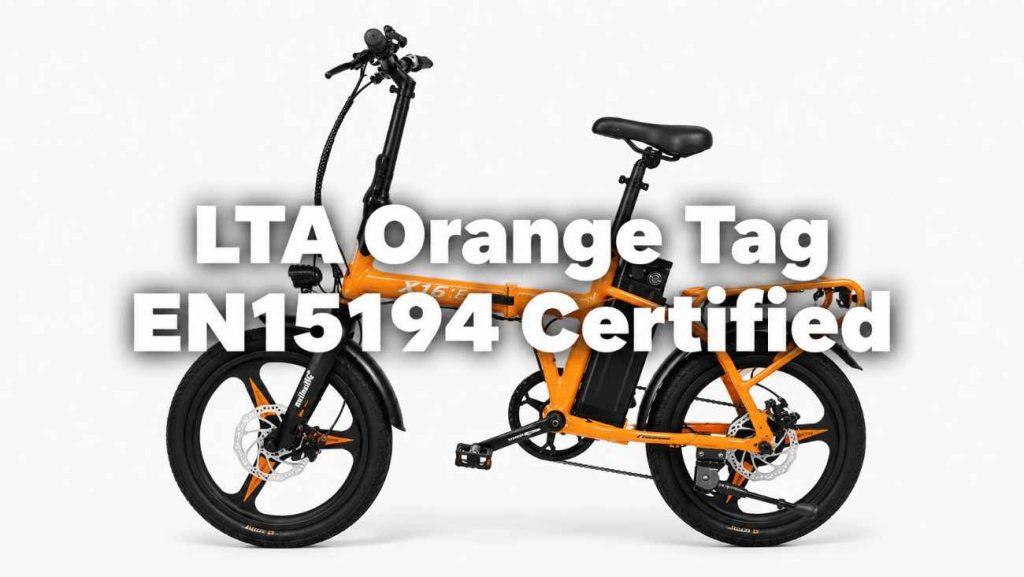
Every LTA-approved PAB must be examined and sealed by an authorised examiner. Maximal describes this as the “LTA Orange Tag.” This tag physically affixed to the bike confirms it has been approved. Do not buy a PAB without it.
2. Check the EN15194 standard.
PABs in Singapore must comply with EN15194. Since 1 July 2021, this must be the revised EN15194:2017 standard (not the older 2009 version). Bikes approved on or after 1 October 2025 must meet Part 5 of the updated Schedule under the Road Traffic (Power-Assisted Bicycles — Approval) Rules. Check the compliance documentation or ask the retailer.
3. Verify via LTA OneMotoring.
You can check PAB registration status at LTA OneMotoring. Registered PABs have a number plate and their details are on the system. If a seller cannot show you an LTA registration number, treat that as a red flag.
4. Why cheap online listings often fail.
E-bikes sold on Lazada and Shopee in the $400-$600 range are almost always grey-market imports. They typically exceed the 25 km/h limit, use uncertified batteries, and have no LTA approval number. Under the Small Motorised Vehicles (Safety) Act 2020, importing a non-compliant PAB without LTA approval carries fines of up to $5,000 for individuals (first offence) and up to $10,000 for repeat offenders. Riding one on public paths means you are also exposed to the use penalties above.
5. UL2272 is for scooters, not PABs.
You will see UL2272 mentioned often when shopping for e-mobility devices. UL2272 is a fire safety standard that applies to PMDs (e-scooters), not PABs. PABs must comply with EN15194. Both the Maximal X16 and X20 are PABs and are certified under EN15194, not UL2272. This distinction matters when verifying compliance.
Can You Modify Your E-Bike to Go Faster?
Short answer: no — and the consequences go well beyond a fine.
What “de-restricting” actually does. Most e-bike speed limiters work through the motor controller’s settings. De-restricting typically means reprogramming or physically bypassing the controller so the motor no longer cuts out at 25 km/h. Some sellers even sell “modification kits” for this purpose.
What it means legally. Once you modify a PAB to exceed its approved specifications, it is no longer the approved device it was when registered. Your LTA registration becomes void. You are operating an unapproved device on public paths — which triggers the penalties listed above.
What it means for insurance. If a modified e-bike is involved in an accident, your insurance will not cover it. You become personally liable for injury or property damage to third parties. Singapore’s personal injury liability exposure in a serious accident is not trivial.
The market for modified bikes is shrinking fast. LTA’s new stationary speed detection device can now flag modified bikes at checkpoints before the rider even moves. Sellers of non-compliant devices face fines of up to $20,000 or imprisonment for up to 24 months. The risk-reward calculation for buying or selling a modified bike has shifted sharply.
Maximal E-Bikes: Built Within The Limit
Both Maximal PABs are designed from the ground up to be legal and stay legal. Here is what that means in practice.
Maximal X16 (PAB-16-02) — $1,369 to $1,859 The X16 is a 16-inch foldable PAB. Key specs:
- 48V 250W geared motor, LTA-approved
- Top speed: 25 km/h (factory set, EN15194 compliant)
- Battery: LG cells, 48V options from 9.6AH to 28.8AH (dual battery supported)
- Weight: from 18.8 kg (with 9.6AH battery)
- 3-mode design — Mode 1 tops out at 24 km/h, so you have a usable everyday mode that stays under the limit
- Folds for MRT and bus transport
- IPX5 rainproof
Maximal X20 (PAB-20-05) — $1,379 to $1,869 The X20 is a full-size 20-inch PAB. Key specs:
- 48V 250W geared motor, LTA-approved
- Top speed: 25 km/h (factory set, EN15194 compliant)
- Battery: LG cells, 48V options from 9.6AH to 28.8AH (dual battery supported)
- Weight: from 18.9 kg (with 9.6AH battery)
- 3-mode design with the same speed-capped approach as the X16
- Does not fold — suited to direct point-to-point rides
Both models include mudguards, rear rack, horn, and lights as standard. Both ship with LTA approval already in place — no grey area, no modifications needed.
Maximal has a physical showroom in Singapore. You can walk in, test ride both models, and get questions answered before buying.
View the Maximal X16 | View the Maximal X20
Frequently Asked Questions
What is the speed limit for e-bikes in Singapore? The maximum motor-assisted speed for a PAB (Power-Assisted Bicycle) is 25 km/h. This applies on all public paths, cycling paths, park connectors, and roads. The motor must stop providing assistance at or above this speed. There is no separate higher limit for roads — 25 km/h is the single national cap.
What happens if I ride an e-bike faster than 25 km/h in Singapore? If your e-bike exceeds 25 km/h because it has been modified or was never compliant, you are riding a non-compliant AMD. First-time offenders face fines of up to $10,000 or imprisonment for up to 6 months or both. Repeat offenders face up to $20,000 or 12 months’ jail or both. The device can also be impounded.
Can LTA check my e-bike speed without me riding it? Yes. Since November 2025, LTA has used a portable speed measurement device that can test an AMD’s maximum speed while it is stationary. Officers no longer need to catch you moving above 25 km/h — they can test the bike at a checkpoint.
What is the difference between EN15194 and UL2272? EN15194 is the safety standard for PABs (e-bikes with pedals). UL2272 is the fire safety standard for PMDs (electric scooters). If you are buying a PAB, check for EN15194 compliance. UL2272 alone does not make an e-bike legal in Singapore.
Is it illegal to modify my e-bike to go faster? Yes. Modifying a PAB to exceed its approved speed voids its LTA registration and makes it illegal to use on public paths. You also lose insurance coverage. Sellers of modified bikes face fines up to $20,000 and potential imprisonment.
Are Maximal e-bikes LTA-compliant? Yes. Both the Maximal X16 (PAB-16-02) and Maximal X20 (PAB-20-05) are LTA-approved PABs with 48V 250W motors capped at 25 km/h in line with EN15194 requirements. They come with the LTA Orange Tag as standard.
Check Compliance Before You Buy — Not After
Three things to take away from this:
- 25 km/h is the hard cap — for the motor, on all paths and roads in Singapore. It is not a guideline.
- Enforcement is no longer just about catching you in the act. LTA can now test your bike’s top speed while it sits stationary at a checkpoint.
- An LTA-approved bike from a reputable retailer is the only safe starting point. Grey-market bikes might cost less upfront, but a $10,000 fine or an impounded device wipes out any saving fast.
The Maximal X16 and X20 are built to these specs from day one. If you want an e-bike that works within Singapore’s rules without any extra homework, start there.
View LTA-approved e-bikes at Maximal SG | Read the Maximal PAB buyer’s checklist
For the official LTA rules, see the LTA Rules & Code of Conduct page.